Respect for Humanity


In today’s “lean” world, the phrase “respect for people” is very popular. This likely results from a poor translation of The Toyota Way (2001). In Japanese, it was “respect for humanity."The original text is 【人間性尊重】.
This “respect for humanity” isn’t unique to Toyota. Some early Japanese TQM pioneers, such as Nishibori and Ishikawa, emphasized the importance of this concept. They underlined the importance of respecting each employee’s creativity and potential.
There’s a notable story from Dr. Ishikawa. He made a clear distinction between “respecting humans” and “respecting humanity.” When asked why he challenged someone who made a presentation on solving a problem, he explained, “I am respecting his humanity.” The point was that if he were “respecting humans,” he should simply praise the work done. But is that truly “respecting humanity”? Does it help that person grow? Ishikawa believed the presenter wasn’t challenging the person’s potential. He had to challenge the person to reach his potential.
The humanity they refer to encompasses potential, creativity, originality, and much more. Everyone has an endless amount of such humanity.
Another discussion involves different kinds of respect. Here, I focus on Sonkei 【尊敬】 and Sonchou 【尊重】. The first symbol already means respect. The difference comes with the second.
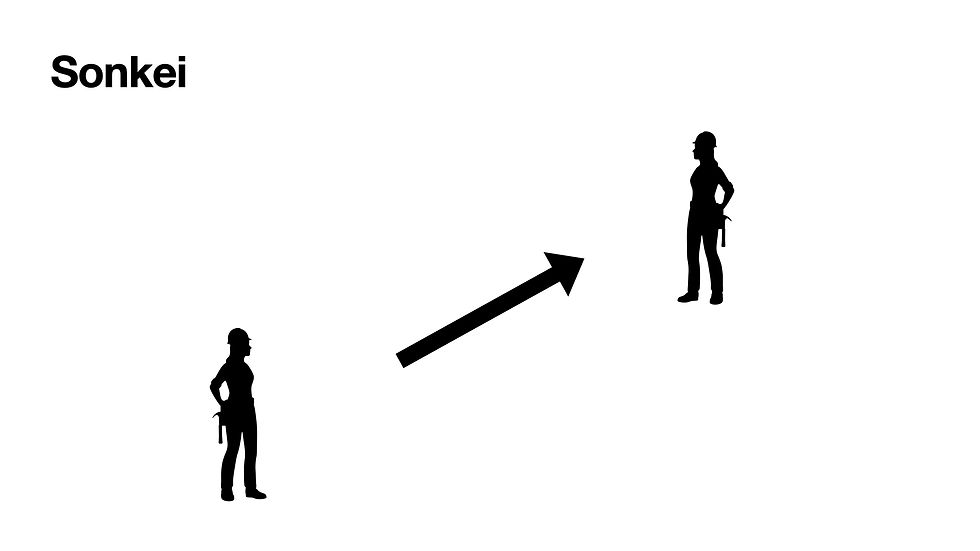
Kei 【敬】 also means respect, but it carries an aspect of worship. It suggests placing someone higher than you. For example, I have great respect for my father. It may seem very Confucian, but I remember my father being above me.

Chou 【重】, which I’ve mentioned before, usually means heavy but also symbolizes importance. In this context, others are seen as equals. For example, I respect your opinion. We will have differences, but we respect each other. We are two equals full of humanity.
So, which form of respect is better when developing or improving?
I’ve seen many places that use the first kind, which has a worship-like aspect. A manager “respects” the engineer. However, the engineer isn’t challenged at all, and the manager’s job becomes simply allocating the budget as instructed. This leads to complacency or spoiling—"Just get a new machine," without solving the current problem or learning from mistakes. I once visited a factory where an engineer presented a problem-solving approach that seemed nonsensical. When I started questioning him, the manager stopped me. I was told to respect the engineer. Later, the engineer admitted that he had come up with the solution to buy new equipment first and then filled the five whys. I saw the same problems elsewhere, and it wasn’t acceptable. Nobody will develop in such an environment.
The type of respect that genuinely matters is recognizing the importance of each person’s humanity. As Taiichi Ohno said, there's a competition for wisdom between the boss and subordinates. Of course, coaches or Ohno are often right because of their experience, but everyone has potential. The coach might be wrong, and it’s rewarding to do Kaizen that exceeds the coach's expectations. That’s when genuine Kaizen begins. I always enjoyed coming up with Kaizen ideas that challenge my coach’s thinking. We must never forget that competition is a good thing, just as it is in sports. Rivals create great players and teams. When there is a rivalry in Kaizen, both the coach and the student develop.
Because of this, I don’t identify as a Sensei or Coach. I see myself as a co-learner and co-challenger.
And this isn’t just about respecting people. Why? Sometimes "people" refers to a group of humans, and some individuals are left out. I’ve seen cases where they respect office workers but not operators. For example, after a natural disaster, office staff were told to work from home, but operators were ordered to come to work. Or during Halloween celebrations with costumes, operators had to wear uniforms for safety and quality reasons—they couldn’t join the party. Respecting people can sometimes mean excluding someone.
To be clear, Toyota never makes such mistakes as excluding plant workers. The genba presents numerous challenges for everyone to develop. Even with a poor translation, the soul is shared. That’s the power of genba.
My coach often says this—something I repeat frequently:
'Respect humans.' We have limited time. Don’t waste anyone’s time.
'Respect humanity.' Our potential is limitless. Involve everyone in Kaizen.


Comments