“When you realize you have made a mistake, do not hesitate to correct it.”

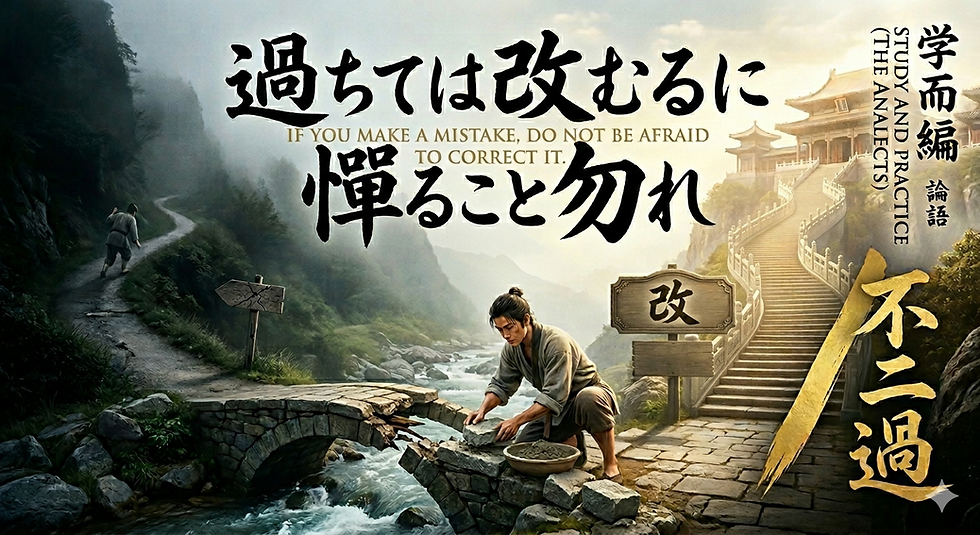
過則勿憚改.
“When you realize you have made a mistake, do not hesitate to correct it.”
— Confucius
This short saying from Confucius captures the essence of Kaizen, the Japanese philosophy of continuous improvement. In modern business, Kaizen is often associated with factories, productivity, and efficiency. But at its core, it is more human: it is about having the courage to recognize mistakes, learn from them, and keep improving.
In this post, we will explore the importance of Kaizen in today’s work and life through the lens of Confucius’s teachings.
What Confucius Is Really Saying
“過則勿憚改” carries three important messages:
1. Everyone makes mistakes. No human is perfect. Errors and wrong decisions are a natural part of life and work.
2. The real problem is not the mistake but refusing to correct it. What harms us most is not the initial error but our pride, fear, or stubbornness that keeps us from changing.
3. We should not be ashamed to correct ourselves. The shame is not in being wrong; it is in seeing the truth and refusing to change.
This mindset is exactly the foundation of Kaizen. Kaizen does not assume a world without mistakes. Instead, it assumes a world where we use mistakes as fuel for improvement.
What Is Kaizen?
Kaizen literally means “self-renew for the better.” In practice, it refers to a way of working where people:
Focus on specific improvements,
Make them continuously,
• In their everyday work, not just during big projects.
The starting point for most improvements is a simple moment of awareness:
• “This step feels complicated.”
• “Customers keep asking the same question.”
• “We made the same mistake again.”
In other words, Kaizen begins when we notice that something is not working well.
Confucius’s teaching then comes in:
When you notice a mistake or a problem, do not hesitate. Correct it.
“Immediately, even if it’s small” — this attitude is the essence of Kaizen.
Why Kaizen Matters Today.
1. A survival strategy in a fast-changing world.
Technology, markets, and customer expectations are changing faster than ever. What worked yesterday can easily become a mistake tomorrow.
To survive and grow in this environment, organizations need to:
• Avoid clinging to old methods just because “this is how we’ve always done it.”
• Stay close to real problems and feedback from the field.
• Be ready to adjust and experiment quickly.
Confucius’s quote encourages this flexibility. Rather than defending our past decisions, we ask: “Given what we know now, how can we do better?”
Companies that embrace Kaizen become more adaptable. They don’t wait for a crisis to prompt change; they change every day.
2. Turning a blame culture into a learning culture.
In many workplaces, mistakes are things to hide.
• People fear being blamed.
• Problems are swept under the rug.
• The same errors repeat because no one talks about them.
A Kaizen environment is completely different. In a Kaizen environment:
• Mistakes, defects, and near-misses are treated as valuable information.
• Reporting a problem early is encouraged, not punished.
• The focus shifts from “Who is at fault?” to “How do we fix the system?”
Confucius does not say, “Don’t make mistakes.” He says, “Don’t hesitate to correct them.” That is a powerful shift:
• From fear to curiosity.
• From hiding to sharing.
• From blaming individuals to improving processes.
This mindset creates safer, more open workplaces where real improvement becomes possible.
3. Connecting personal growth with organizational growth.
Kaizen is not only a management technique. It is a way of living and working as an individual.
On a personal level, Kaizen can look like this:
• Regularly reviewing how you work and finding one thing to improve.
• Learning from feedback instead of taking it as a personal attack.
• Asking yourself: “What can I do 1% better today than yesterday?”
When many individuals think and act this way, the organization naturally becomes more effective and innovative. Confucius’s quote becomes a daily question:
When I notice a mistake — in my work, my habits, my decisions — how quickly and humbly do I correct it?
Over the years, this small question can shape a career, a team, and even an entire company's culture.
How to Embed Kaizen in Everyday Work.
How can we bring Confucius’s wisdom and the spirit of Kaizen into our daily work? Here are a few practical steps:
1. Make problems visible. Track errors, delays, customer complaints, and quality issues in a place everyone can see. The key rule: never punish people for surfacing problems.
2. Ask “Why?” multiple times. Instead of stopping at “who caused it,” dig deeper: Why did it happen? Why was it not caught earlier? What in the process allowed this? This shifts attention from people to systems.
3. Start with very small experiments. You don’t need a perfect solution. Try a small change for a week or a month. Observe the results. Adjust again. Kaizen grows through many small, low-risk experiments.
4. Celebrate improvements, not just results. Recognize people who propose and test improvements, even if the results are modest. Share simple examples: a new checklist, a clearer template, a better layout for tools.
5. Leaders go first in admitting mistakes. When managers openly say “I was wrong” or “I changed my mind based on new information,” they send a strong signal: correcting yourself is safe and respected. This is exactly what Confucius asked us not to fear.
Conclusion: From an Ancient Saying to Modern Kaizen.
“When you realize you have made a mistake, do not hesitate to correct it.”
Although Confucius spoke these words more than 2,000 years ago, they perfectly describe the spirit of modern Kaizen.
• Mistakes are not the end; they are the beginning of learning.
• The real danger is not being wrong, but refusing to change when we see a better way.
• When individuals have the courage to correct themselves, organizations become capable of continuous renewal.
Kaizen is not a one-time project or a special campaign. It is the daily decision to say:
• “I was wrong.”
• “I learned something.”
• “Let’s try a better way.”
By living out Confucius’s advice in our work and our teams, we build a culture where improvement never stops — and where both people and organizations can keep growing, one small step at a time.


Comments